
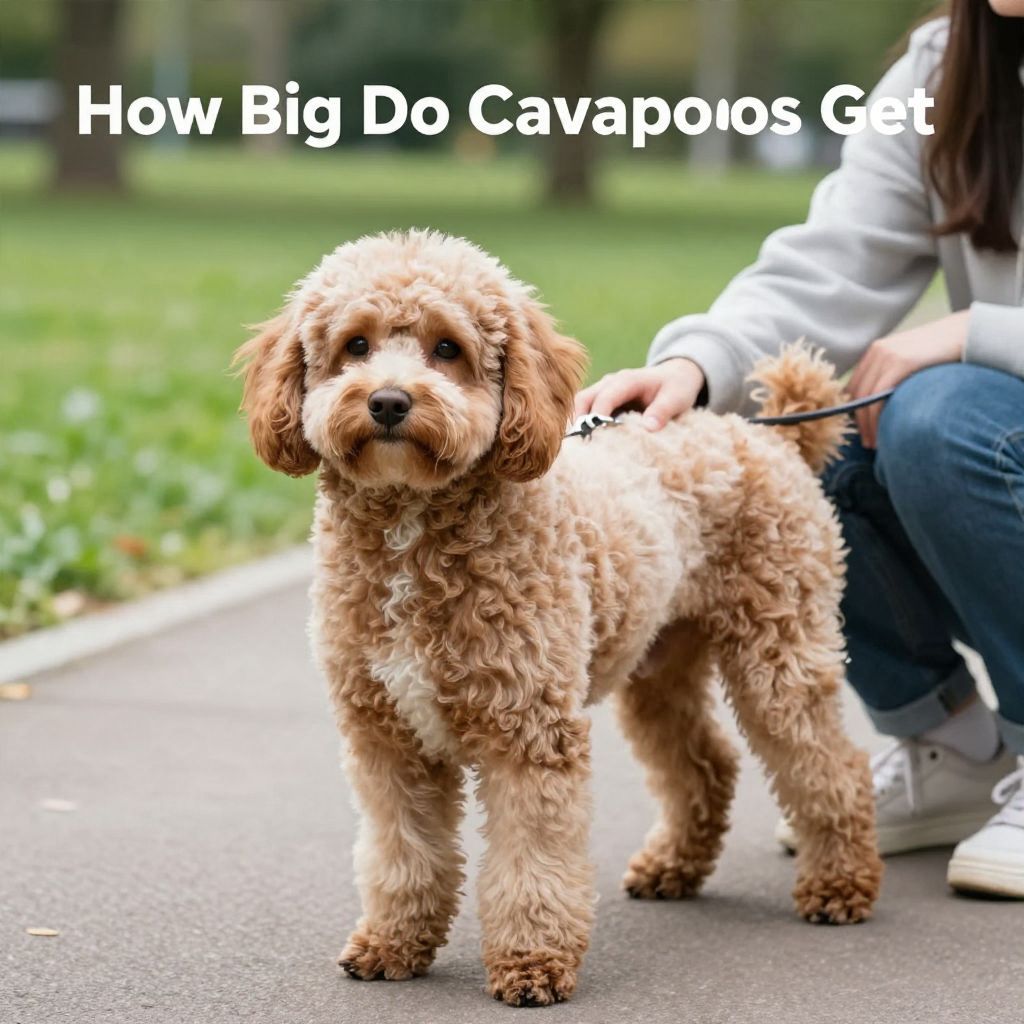
If you’re wondering how big Cavapoos get, the short answer is that most are small dogs, but their adult size can vary a lot. A Cavapoo’s final height and weight depend mainly on whether the parent was a Cavalier King Charles Spaniel and a Toy or Miniature Poodle.
That means some Cavapoos stay very petite, while others grow into sturdier small-to-medium dogs. Knowing the likely size range helps you plan for feeding, exercise, grooming, travel, and the right crate, bed, and harness.
How big do Cavapoos get?
Most Cavapoos reach about 9 to 14 inches tall and roughly 7 to 20 pounds as adults, but there is no single exact size. Puppies from smaller Poodle lines usually stay smaller, while those with a Miniature Poodle parent often grow larger. Individual genetics, diet, and overall health also affect adult size.
What affects a Cavapoo’s adult size?
Cavapoos are a mixed-breed dog, so size is not perfectly predictable. The biggest factors are the size of the Poodle parent, the size of the Cavalier parent, and the puppy’s own inherited traits.
Parent size matters most
- Toy Poodle lines usually produce smaller Cavapoos.
- Miniature Poodle lines often produce larger Cavapoos.
- If the breeder uses smaller or larger parents within those ranges, the puppies can shift noticeably in size.
Age and growth stage matter too
Cavapoo puppies grow quickly in the first several months, then gradually fill out. Many reach most of their height by around 8 to 12 months, but they may continue to mature in body condition and muscle until about 12 to 18 months.
Health and nutrition can influence growth
Good nutrition supports healthy development, but overfeeding does not create a better-grown dog. It can instead increase the risk of excess weight, which is especially hard on small joints and the heart.
Typical Cavapoo size by age
Every puppy is different, but this general guide can help you understand what to expect as your Cavapoo grows.
- 8 weeks: very small and lightweight, often easy to carry in one arm
- 4 to 6 months: rapid growth phase; legs and body may look a little awkward as proportions change
- 6 to 9 months: closer to adult height, with continued filling out
- 9 to 18 months: most are near adult size, though body shape may still refine
If your puppy seems much smaller or larger than littermates, that can still be normal. What matters most is steady growth, good appetite, normal energy, and your veterinarian’s assessment at routine visits.
How to tell if your Cavapoo will be small or larger
You can get clues, but not a guarantee. A breeder who knows the parents’ sizes can often give you a better estimate than visual guesswork alone.
Helpful clues
- Parent weights and heights are the best predictor.
- Paw size can be suggestive, but it is not reliable on its own.
- Growth rate during the first few months may hint at adult size.
- Veterinary growth checks can help confirm whether your puppy is developing normally.
Be cautious with promises like “teacup” or “guaranteed mini” unless the breeder can explain the parents’ actual sizes and health history. Extremely small dogs can have higher health risks, and size should never come before welfare.
How big a Cavapoo feels in daily life
Even a small Cavapoo can feel different from one household to another. A 10-pound dog may be easy to lift, while a 20-pound dog can still be compact but noticeably heavier for stairs, travel, and grooming.
Practical things to plan for
- Crate size: choose one that allows standing, turning, and lying down comfortably.
- Harness fit: small dogs still need a secure, well-fitted harness for walks.
- Furniture access: consider ramps or steps if your dog jumps often.
- Travel: a carrier or seat restraint should match your dog’s adult size, not just puppy size.
How size affects feeding and body condition
Cavapoos are small enough that even a little extra weight can matter. Instead of feeding based only on the cup amount on a bag, use your dog’s body condition, age, activity level, and your veterinarian’s advice.
Signs your Cavapoo may be at a healthy weight
- You can feel the ribs with light pressure, but not see them clearly.
- Your dog has a visible waist when viewed from above.
- The belly tucks up slightly from the side.
Signs your dog may be gaining too much weight
- Ribs are hard to feel under the coat
- Less interest in exercise or play
- Difficulty jumping, climbing, or keeping up on walks
If you are unsure, ask your veterinarian to score your dog’s body condition. That is more useful than guessing by appearance alone, especially in fluffy breeds like Cavapoos.
Exercise needs for a Cavapoo of any size
Size affects stamina and joint strain, but most Cavapoos still need regular daily activity. Many do well with a mix of walks, play, and short training sessions.
Good exercise options
- Two or more short walks
- Fetch or tug with rules and pauses
- Food puzzles and sniffing games
- Basic training practice for mental work
Very young puppies need shorter, gentler activity. Avoid overdoing stairs, repetitive jumping, or long runs while growth plates are still developing.
Grooming and coat care as your Cavapoo grows
Cavapoos often have wavy to curly coats that need regular upkeep, regardless of size. A smaller dog can still mat quickly if the coat is not brushed and trimmed consistently.
Size-related grooming tips
- Use a slicker brush and comb to check for tangles close to the skin.
- Keep hair around the eyes, ears, feet, and sanitary areas tidy.
- Schedule professional grooming if home maintenance becomes difficult.
If you want to learn more about coat care, you may also find this guide useful: Do Cavapoos Shed?
When a Cavapoo’s size may be a health concern
Most Cavapoos are healthy when they are well bred, well fed, and given routine veterinary care. Still, size that seems unusually small, large, or uneven can sometimes point to a problem.
Call your veterinarian if you notice
- Poor weight gain or sudden weight loss
- Repeated vomiting or diarrhea
- Lethargy, weakness, or low appetite
- Difficulty breathing, especially in a small dog
- Limping, pain, or trouble moving normally
Seek urgent veterinary care if your Cavapoo has trouble breathing, collapses, has a swollen painful abdomen, cannot stand, or may have eaten something toxic or dangerous.
Common mistakes owners make about Cavapoo size
It is easy to assume a puppy will stay tiny because of its fluffy appearance. That can lead to buying the wrong supplies or underestimating adult needs.
- Choosing gear too small. Puppies grow quickly, so check fit often.
- Overfeeding “just in case.” Extra food does not equal better growth.
- Expecting one exact adult size. Mixed breeds can vary widely.
- Ignoring body condition. A healthy weight matters more than a specific number on the scale.
- Skipping vet checks. Growth concerns are easier to address early.
How to prepare for your Cavapoo’s adult size
If you are bringing home a puppy, plan for the upper end of the expected range so you do not outgrow essential items too quickly. That is usually the safest and most cost-effective approach.
Smart preparation checklist
- Buy an adjustable harness and collar
- Choose a crate with enough room for adult size
- Use a scale or vet visits to track growth
- Keep up with parasite prevention and vaccinations
- Feed a complete diet appropriate for the puppy’s life stage
When to ask a breeder or veterinarian for more guidance
If you are still trying to estimate how big your Cavapoo will get, ask for the parents’ actual weights, ages, and health information. A responsible breeder should be transparent about size expectations and any relevant medical screening.
Your veterinarian can also help if your puppy’s growth seems unusual, if you are unsure about body condition, or if you need help choosing food, exercise, or grooming tools that fit your dog’s current and future size.
In short, most Cavapoos grow into small dogs, but their adult size is not fixed. Focus on the parents’ size, monitor healthy growth, and adjust feeding, exercise, and equipment as your dog matures. If you want a broader comparison with another popular doodle mix, you may also like reading about how big Mini Goldendoodles get.