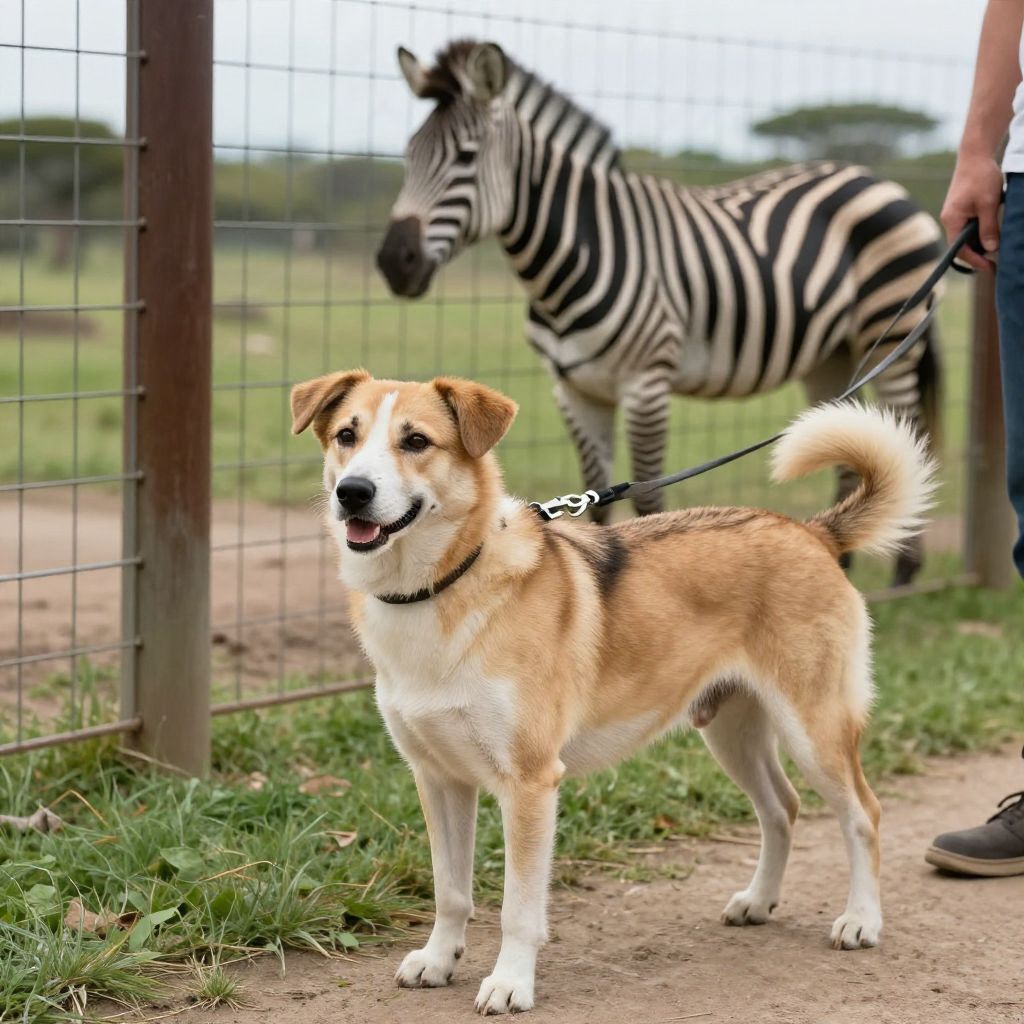
Is a zebra a horse? Not exactly. Zebras and horses are close relatives in the equid family, but they are different animals with different temperaments, body features, and care needs.
If you’re asking because your dog saw a zebra at a zoo, on a farm, or in a video, the main takeaway is simple: treat zebras as wild animals, not as horses. That matters for your dog’s safety, your safety, and the animal’s welfare.
Is a zebra a horse?
No. A zebra is not a horse, although both belong to the equid family and share a common ancestry. Zebras are wild animals with distinct stripes, behavior, and handling needs, while horses are domesticated and generally more accustomed to human care and training.
Why the difference matters for dog owners
For dogs, the question is less about biology trivia and more about safety. A zebra is not a “friendly horse substitute,” and a dog that approaches one may be at risk of being kicked, bitten, or chased.
Even a calm-looking zebra can react quickly if it feels threatened. Your dog’s curiosity, prey drive, or excitement can turn a simple encounter into an emergency.
How zebras differ from horses
Although they look similar at a glance, zebras and horses are not interchangeable. Understanding the differences helps you make safer choices around animals and avoid assuming a zebra will behave like a horse.
Behavior and handling
- Horses have been domesticated for thousands of years and are often trained for riding, driving, or farm work.
- Zebras remain wild animals and are typically more reactive, less predictable, and harder to handle safely.
- Both can kick and bite, but zebras are generally less accustomed to close human contact.
Appearance and physical traits
- Zebras have distinctive stripes that vary by species and individual.
- They are built for survival in the wild, not for domesticated work.
- Horses have been selectively bred for many sizes, shapes, and jobs.
Care and environment
- Horses may live safely in managed domestic settings with proper training, fencing, nutrition, and veterinary care.
- Zebras require specialized, secure facilities and experienced handlers.
- Trying to treat a zebra like a horse can create serious welfare and safety problems.
What to do if your dog encounters a zebra
If you are near a zebra and have a dog with you, the safest move is to create distance immediately. Do not encourage sniffing, chasing, or “meeting” the animal, even if the zebra appears calm.
- Leash your dog right away if it is not already restrained.
- Move away slowly and calmly.
- Avoid sudden movements, yelling, or letting your dog lunge.
- Keep your dog behind you if possible.
- Leave the area if the zebra shows alert, stiff, or agitated body language.
Never assume a zebra is safe because it is standing still. Wild animals may react fast when a dog gets too close.
Signs your dog may be too excited or stressed around large animals
Some dogs stay relaxed around unusual animals, while others become highly aroused or fearful. Your dog’s age, breed tendencies, training history, and past experiences can all affect the reaction.
- Staring intensely or fixating
- Pulling hard on the leash
- Barking, whining, or lunging
- Crouching low or trying to flee
- Raised hackles, stiff posture, or tucked tail
- Refusing treats because of fear or overstimulation
If your dog regularly reacts strongly to horses, livestock, or other large animals, ask a qualified trainer or veterinary behaviorist for help with desensitization and counterconditioning.
How to keep your dog safe around farms, zoos, and wildlife areas
Good management prevents most problems. Even well-trained dogs can make poor choices when they are excited, tired, or startled.
Before you go
- Check whether dogs are allowed at the location.
- Use a secure leash and well-fitting harness or collar.
- Bring water and rewards if your dog is comfortable working for treats.
- Know your dog’s triggers before you encounter them.
During the visit
- Keep your dog at a distance from fences, pens, and gates.
- Do not let your dog bark at or stare down animals.
- Reward calm attention and loose-leash walking.
- Leave early if your dog becomes overstimulated.
After the visit
- Watch for pawing, panting, trembling, or unsettled behavior.
- Check for injuries if there was any contact with an animal or fence.
- Contact your veterinarian if your dog was kicked, bitten, or knocked down.
Common mistakes dog owners make
People sometimes underestimate the risk because zebras look similar to horses from a distance. That can lead to preventable accidents.
- Assuming a zebra is “basically a horse” and safe to approach
- Letting a dog off leash near livestock or wildlife
- Encouraging a dog to “say hello” to a large animal
- Misreading fear or excitement as friendliness
- Waiting to seek help after a bite, kick, or collision
When in doubt, choose distance over curiosity. That is the safest and most responsible option for your dog.
If your dog is injured near a zebra
Any bite, kick, or blunt-force injury from a large animal should be taken seriously. Some injuries are obvious, but others can be hidden at first.
Call a veterinarian promptly if you notice swelling, limping, bleeding, pain, trouble breathing, collapse, or reluctance to move. Seek urgent veterinary care immediately if your dog cannot stand, has heavy bleeding, seems disoriented, has pale gums, or is having difficulty breathing.
Red flags that need emergency care
- Open wounds or punctures
- Rapid swelling
- Weakness or collapse
- Vomiting after trauma
- Signs of shock, such as pale gums or cold limbs
- Severe pain or crying out when touched
Do not try to manage a serious injury at home. A veterinarian can assess pain, internal injury risk, infection risk, and whether imaging or wound care is needed.
Training your dog to stay calm around unusual animals
If your dog is likely to encounter horses, zebras, or other large animals, basic impulse-control training can help. The goal is not to force your dog to “ignore everything,” but to teach safer choices.
- Practice loose-leash walking in low-distraction settings first.
- Reward your dog for checking in with you.
- Use distance as a training tool; start far enough away that your dog can still think.
- Pair the sight of distant animals with treats if your dog remains calm.
- End sessions before your dog becomes overwhelmed.
Reward-based methods are the safest and most effective approach for most dogs. Avoid punishment, leash jerks, or intimidation, which can increase fear and reactivity.
When to ask a professional for help
If your dog has a strong prey drive, has previously chased livestock, or becomes highly reactive around large animals, professional guidance can make a big difference. A certified trainer or veterinary behaviorist can help you build a safer plan.
Get help sooner if your dog has:
- Repeated lunging or chasing behavior
- Fearful reactions that are getting worse
- Difficulty recovering after exposure
- A history of biting or snapping
Professional support is especially useful if you live near farms, trail systems, or properties with mixed animals.
Bottom line
A zebra is not a horse, and that difference matters for your dog’s safety. Keep your dog leashed, give zebras plenty of space, and treat any close encounter as a potential risk. If your dog is injured or reacts strongly around large animals, contact your veterinarian or a qualified trainer for next steps.