
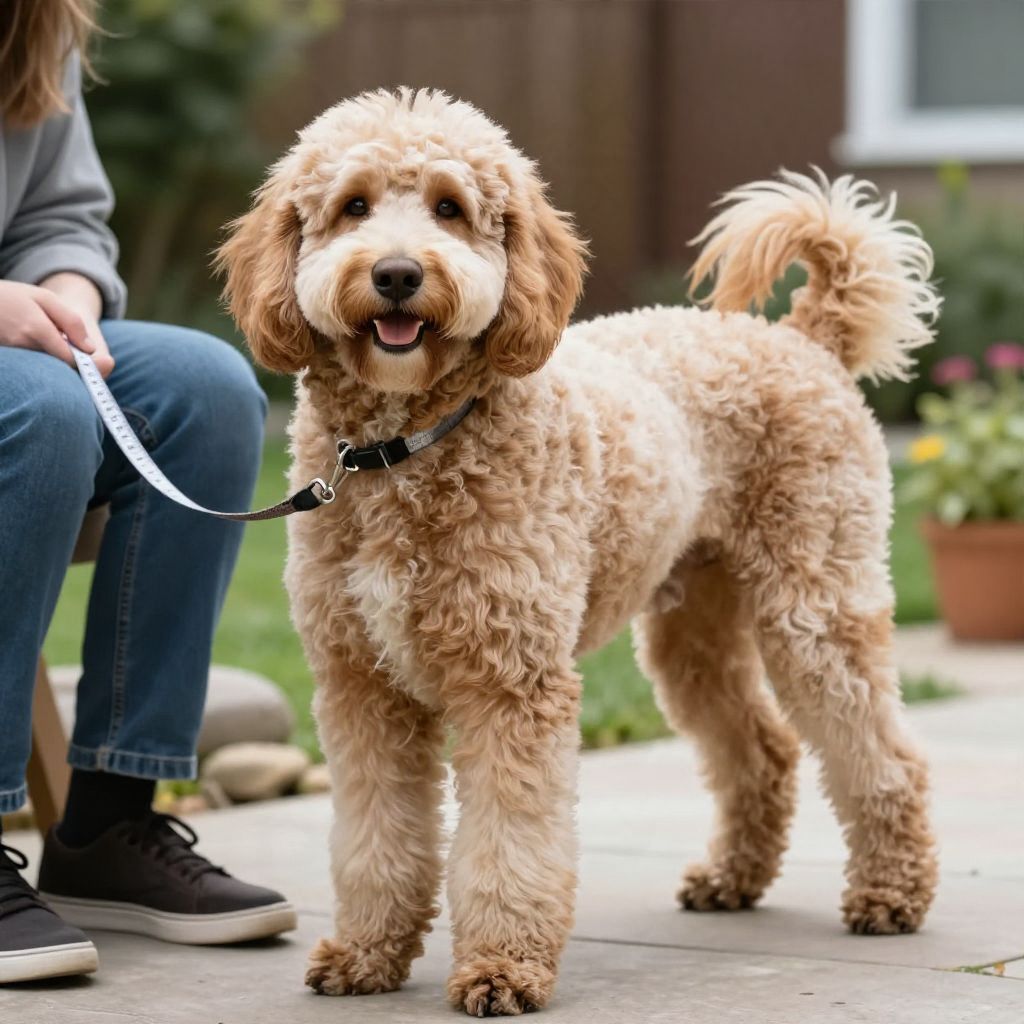
How big is a Mini Goldendoodle? Most Mini Goldendoodles are small-to-medium dogs, but their adult size can vary based on the Poodle parent, the Golden Retriever parent, and the puppy’s individual genetics. If you’re choosing one, it helps to understand the usual height, weight, and growth stages.
Knowing the expected size also helps you plan for food, exercise, grooming, travel, and home setup. A Mini Goldendoodle is often a good fit for people who want a companion that is easier to carry and house than a standard Goldendoodle, but still active and sturdy.
How big is a Mini Goldendoodle?
A Mini Goldendoodle usually stands about 13 to 20 inches tall at the shoulder and weighs roughly 15 to 35 pounds when fully grown. Some are smaller or larger depending on genetics, sex, diet, and overall health. There is no single exact size, so expect a range rather than a guarantee.
What affects a Mini Goldendoodle’s adult size?
Mini Goldendoodles are mixed-breed dogs, so adult size can be influenced by several factors. The most important are the size of the parent dogs and the size traits passed down to the puppy.
- Parent size: A smaller Poodle parent usually leads to a smaller adult dog.
- Genetics: Puppies in the same litter can still grow to different sizes.
- Sex: Males are often a little larger than females, though not always.
- Nutrition and health: Good nutrition supports normal growth, while illness or poor feeding can affect development.
- Age: Puppies grow quickly at first, then gradually fill out as adolescents.
If you are buying from a breeder, ask for the parents’ adult weights and heights. That gives you a better estimate than relying on the “mini” label alone.
How fast do Mini Goldendoodles grow?
Mini Goldendoodle puppies grow rapidly during the first several months, then slow down as they approach adulthood. Many reach most of their height by around 9 to 12 months, but some continue to gain muscle and fill out until 12 to 18 months.
Typical growth stages
- 8 to 12 weeks: Very small, still developing coordination and bite inhibition.
- 3 to 6 months: Noticeable height gain and increased energy.
- 6 to 12 months: Slower growth, more adult-like body shape.
- 12 to 18 months: Final filling out, especially in chest and muscle tone.
Growth rates vary, so avoid comparing your puppy too closely with another dog of the same breed mix. A vet can tell you if your puppy is tracking normally.
How do Mini Goldendoodles compare with other Goldendoodle sizes?
Mini Goldendoodles are smaller than standard Goldendoodles and often a bit larger than toy-sized doodles. Exact size labels can vary by breeder, so it helps to ask for measurements instead of assuming the name tells the full story.
- Toy Goldendoodle: Usually the smallest category.
- Mini Goldendoodle: Commonly small-to-medium sized.
- Standard Goldendoodle: Much larger and more physically demanding to manage in some homes.
If size matters for your lifestyle, ask about expected adult weight, current puppy weight, and the size of both parents. That is more useful than the breed label alone.
How can you estimate a Mini Goldendoodle puppy’s adult size?
You can make a rough estimate, but no method is exact. The best clues are the puppy’s age, current weight, and the size of the parents. Your veterinarian can also help you judge whether growth looks on track.
- Ask the breeder for both parent dogs’ adult size.
- Check the puppy’s current weight and age.
- Compare the puppy’s growth over time, not just one weigh-in.
- Use your vet visits to confirm healthy body condition and growth.
Be cautious with online size calculators. They can be a rough guide, but mixed-breed dogs do not always follow neat formulas.
What does a healthy Mini Goldendoodle body look like?
Weight alone does not tell you whether a Mini Goldendoodle is healthy. A fit dog should have a visible waist when viewed from above and a tucked-up abdomen from the side, though coat type can make this harder to see.
Signs your dog may be at a healthy size
- You can feel the ribs with light pressure, but they are not sharply visible.
- Your dog moves comfortably and can play without obvious strain.
- Energy levels are appropriate for age and health.
- Your vet is happy with body condition score and growth pattern.
If your dog seems too thin, is gaining weight quickly, or has a pot-bellied look, schedule a veterinary exam. Rapid changes can point to diet issues, parasites, or other health concerns.
How much exercise does a Mini Goldendoodle need?
Mini Goldendoodles are usually active dogs that need regular daily exercise, but the exact amount depends on age and health. Puppies need shorter, gentler activity, while adults often do well with walks, play sessions, and training-based enrichment.
- Puppies: Short play sessions, brief walks, and lots of rest.
- Adults: Daily walks plus mental stimulation such as training or puzzle toys.
- Seniors: Lower-impact activity adjusted for joints and stamina.
Because they are small-to-medium dogs, Mini Goldendoodles can sometimes be overexercised by enthusiastic owners. Watch for lagging behind, heavy panting, or stiffness afterward.
How does size affect feeding?
Smaller dogs need less total food than larger dogs, but Mini Goldendoodles still need a complete, balanced diet that matches their life stage. Puppies, adults, and seniors have different nutritional needs.
Feeding tips by life stage
- Puppies: Feed a puppy-formulated diet and follow your vet’s guidance on meal frequency.
- Adults: Use measured meals rather than free-feeding when possible.
- Seniors: Monitor weight closely, especially if activity drops.
Do not guess portions based only on the breed name. A 15-pound Mini Goldendoodle and a 35-pound Mini Goldendoodle will not need the same amount of food.
What grooming needs come with a Mini Goldendoodle?
Mini Goldendoodles often have wavy or curly coats that need regular grooming. Coat type varies a lot, so some dogs shed more or mat more easily than others. Size does not reduce grooming needs.
- Brush several times a week, or more often if the coat tangles easily.
- Check ears regularly, especially if your dog has floppy ears.
- Trim nails before they get long enough to affect gait.
- Schedule professional grooming as needed to prevent matting.
Small dogs can still develop painful mats, especially behind the ears, under the collar, and around the legs. Grooming is not just cosmetic; it helps skin stay healthy.
Are Mini Goldendoodles good for apartments or small homes?
Many Mini Goldendoodles can adapt well to smaller living spaces if their exercise, training, and enrichment needs are met. Size helps, but it is not the only factor. A bored or underexercised dog may still become noisy or destructive in any home.
Before choosing one, think about barking, training time, and daily activity. A smaller dog is easier to house indoors, but it still needs structure and attention.
When should you call a vet about size or growth concerns?
Contact your veterinarian if your Mini Goldendoodle is not growing as expected, seems weak, or has a sudden change in appetite or weight. Growth problems are easier to address early.
Red flags that need prompt veterinary care
- Sudden weight loss or failure to gain weight in a puppy
- Vomiting, diarrhea, or refusal to eat for more than a short period
- Swollen belly, trouble breathing, or collapse
- Limping, pain, or reluctance to move
- Marked lethargy or dehydration
If your puppy seems to be growing too quickly, too slowly, or unevenly, ask your vet to check body condition, joints, and overall health. Do not try to correct growth with supplements unless your vet recommends them.
Common mistakes people make about Mini Goldendoodle size
Many owners are surprised when a “mini” dog turns out larger than expected. Others assume the puppy will stay tiny forever. Mixed-breed dogs can be unpredictable, so planning ahead is important.
- Assuming “mini” means toy-sized.
- Choosing a puppy without asking about the parents’ size.
- Overfeeding because the dog looks small and cute.
- Underestimating exercise and grooming needs.
- Ignoring body condition and focusing only on the number on the scale.
The best approach is to treat size as a range, then adjust care based on the individual dog in front of you.
How to choose the right Mini Goldendoodle for your home
If you are selecting a puppy or adult dog, think about more than weight. Temperament, energy level, house-training progress, and health history matter just as much as size.
- Ask how big the parents are and whether previous litters were similar in size.
- Ask about vet care, vaccination status, and deworming.
- Observe the puppy’s confidence, curiosity, and handling tolerance.
- Make sure you can meet exercise, grooming, and training needs.
A well-matched Mini Goldendoodle should fit your daily routine, not just your space.
In short, a Mini Goldendoodle is usually a small-to-medium dog, often around 13 to 20 inches tall and 15 to 35 pounds, but individual dogs can fall outside that range. For the most accurate picture, look at the parents, monitor growth, and check in with your veterinarian if anything seems off. If you want to learn more, read more about Mini Goldendoodle size and learn about Mini Goldendoodle lifespan.