
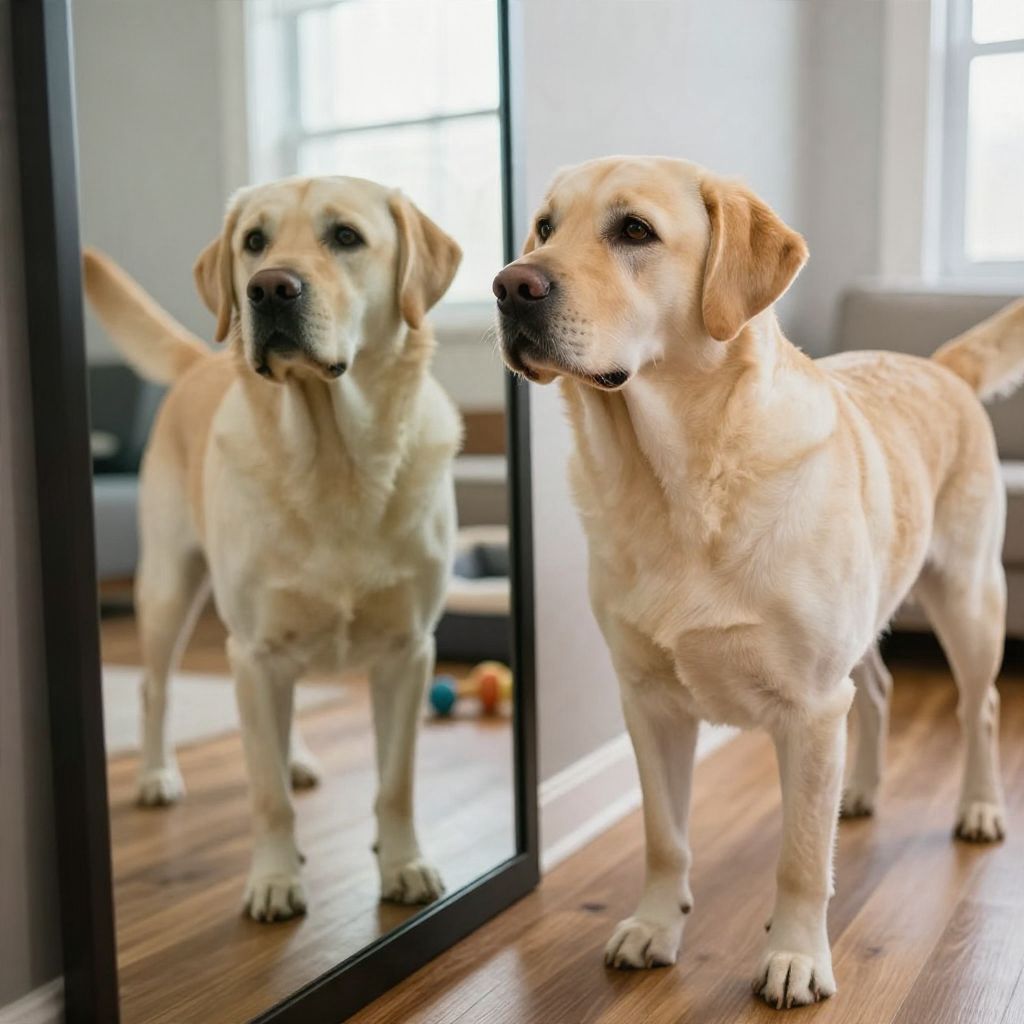
Can dogs recognize themselves in the mirror? Usually, no in the human sense. Most dogs react to a mirror image as if it is another dog or simply an interesting visual stimulus, though a few may learn that the reflection is not a real animal.
That reaction is usually normal. A mirror test does not tell you whether your dog is “smart” or “self-aware,” and it can be confusing or stressful for some dogs, especially puppies, anxious dogs, or dogs with vision or cognitive changes.
Can dogs recognize themselves in the mirror?
Most dogs do not reliably recognize themselves in the mirror the way humans often do. They may investigate, ignore the reflection, or treat it like another dog. Some dogs learn the mirror is not a real companion, but that does not mean they understand the image as “me.”
Why mirrors are confusing for dogs
Dogs rely far more on smell, hearing, movement, and context than on visual self-recognition. A mirror gives them only a visual image, without scent or normal body cues, so it can be hard for them to interpret.
What your dog may do
- Stare at the reflection.
- Look behind the mirror or around it.
- Bark, growl, or posture at the “other dog.”
- Lose interest after a short time.
- Use the mirror as background and ignore it completely.
What that behavior does and does not mean
These reactions do not prove your dog is confused, aggressive, or unusually intelligent. They usually show that your dog is trying to make sense of a visual cue that does not match scent or movement in the real world.
Is the mirror test useful for dogs?
The classic mirror test was designed around species that use visual self-recognition. For dogs, it is not a very meaningful measure because their strongest senses are different. A dog that ignores a mirror is not necessarily less aware than a dog that investigates it.
In practical terms, the mirror is more useful as a window into your dog’s curiosity, confidence, and response to novelty than as a test of self-awareness.
When mirror behavior is normal
Most mirror reactions are harmless and temporary. Your dog may simply be curious, startled, or uninterested.
- Puppies often react more because everything is new.
- Confident dogs may investigate briefly and move on.
- Shy or anxious dogs may avoid the area or bark once or twice.
- Older dogs may react less if vision, hearing, or cognition has changed.
As long as your dog settles quickly and does not seem distressed, mirror interest alone is usually not a problem.
When mirror behavior may signal a problem
Occasional barking at a mirror is not usually concerning. But persistent fear, agitation, or disorientation can point to a broader issue rather than a mirror problem itself.
Call your veterinarian if you notice:
- Sudden changes in vision or bumping into objects.
- New confusion, restlessness, or nighttime pacing.
- Frequent staring at reflections with clear distress.
- Repeated barking or lunging that is new for your dog.
- Other behavior changes, such as house-soiling, sleep changes, or altered appetite.
These signs can be associated with eye disease, pain, hearing loss, anxiety, or age-related cognitive changes. A veterinarian can help sort out what is normal curiosity and what needs treatment.
How age, breed, and temperament can affect mirror reactions
There is no single breed rule for mirror behavior. Individual dogs vary widely based on temperament, life experience, and training history.
Puppies
Puppies are more likely to treat a mirror as a novelty. Gentle exposure is usually enough; there is no need to force interaction.
Adult dogs
Adult dogs may ignore mirrors if they have learned the reflection is not relevant. Others continue to react, especially in unfamiliar rooms or new environments.
Senior dogs
Older dogs may show less interest, or they may seem more confused if their vision or cognition has changed. A sudden shift in mirror behavior in a senior dog deserves a veterinary check.
How to help your dog stay calm around mirrors
If your dog fixates on a mirror, the goal is not to “teach self-recognition.” The goal is to reduce stress and help your dog feel safe.
- Keep your tone calm and neutral.
- Do not punish barking or growling at the reflection.
- Redirect your dog with a treat scatter, toy, or simple cue they already know.
- Increase distance from the mirror if your dog seems tense.
- Cover or remove a mirror if it is causing repeated stress in a specific room.
If your dog is worried by reflections, reward relaxed behavior near the mirror rather than forcing direct contact with it.
Common mistakes owners make
Mirror behavior can be amusing, but a few common mistakes can make it worse.
- Encouraging prolonged staring when the dog is already tense.
- Using punishment for barking or growling, which can increase fear.
- Assuming all reactions are dominance or aggression instead of stress or confusion.
- Ignoring sudden behavior changes in an older dog.
- Forcing repeated exposure instead of letting the dog disengage.
Could a dog ever learn the mirror is not another dog?
Some dogs do seem to learn that the reflection is not a separate animal. They may stop reacting, glance once, and move on. That is a learned response, not clear proof of human-like self-recognition.
Because dogs depend heavily on scent, they may not use mirrors the way people do. A dog can understand that a reflection is unimportant without understanding it as “my own body.”
What to do if your dog is obsessed with reflections
Some dogs become fixated on mirrors, shiny appliances, windows, or other reflective surfaces. If that happens, look at the bigger picture rather than the mirror alone.
Try these practical steps
- Reduce access to the trigger when you cannot supervise.
- Increase mental and physical enrichment with walks, sniffing, and training games.
- Use reward-based training to reinforce calm attention away from reflections.
- Check whether the behavior happens more when your dog is bored, under-exercised, or anxious.
- Speak with your veterinarian if the fixation is new, intense, or paired with other changes.
Sometimes what looks like a mirror issue is really a sign of boredom, stress, sensory decline, or a medical problem.
When to seek veterinary or behavior help
Reach out for professional help if your dog’s mirror reactions are intense, escalating, or part of a larger pattern of behavior change. A veterinarian can rule out pain, eye problems, neurologic issues, or cognitive decline.
A certified trainer or veterinary behaviorist can help if your dog is fearful, reactive, or unable to settle around reflections. Humane, reward-based support is the safest approach.
Urgent red flags
- Sudden blindness or obvious vision loss.
- Disorientation, circling, or collapse.
- Severe agitation that does not improve.
- New aggression that could put people or other pets at risk.
- Any behavior change with vomiting, weakness, or other illness signs.
Bottom line
Can dogs recognize themselves in the mirror? Usually not in the human sense, and that is normal. Most dogs either ignore the reflection or treat it like a strange visual cue. Focus on your dog’s comfort, not the mirror test, and ask your veterinarian if behavior changes are sudden or concerning.
If you want to learn more about canine perception, you may also find how dogs see the world helpful, along with this deeper look at mirror recognition in dogs.