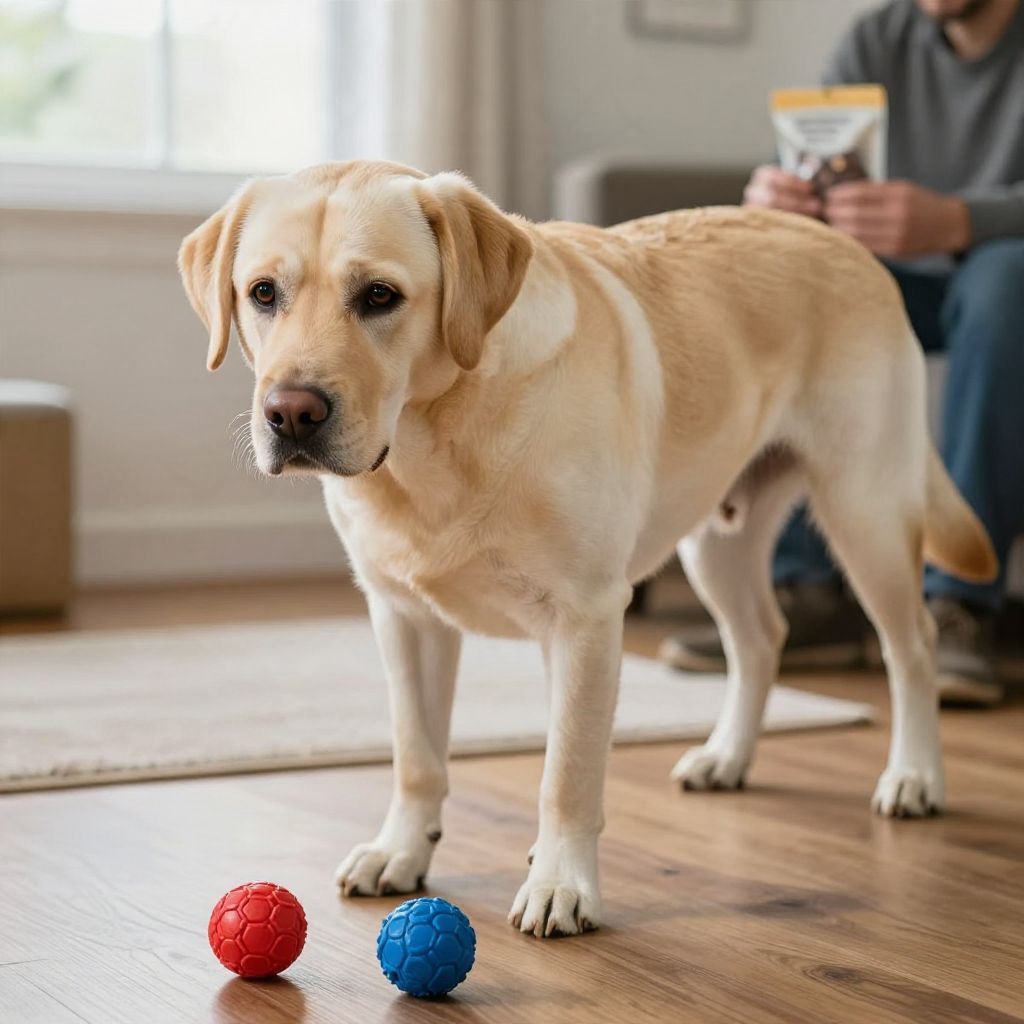
If you’re wondering whether dogs can see red, the short answer is yes, but not the way humans do. Dogs do not see the full rainbow of colors we do, and red often looks muted, brownish, or grayish to them.
That matters for toys, training tools, and safety cues. Understanding how your dog sees color can help you choose better enrichment items and avoid assuming your dog will notice red objects the same way you do.
Can dogs see red?
Dogs can detect red light, but they do not perceive red as a vivid human-like color. Their vision is limited compared with ours, so red usually appears more like a dull brown, dark yellow, or grayish tone rather than bright red.
How dog color vision works
Dogs have fewer color-detecting cells in their eyes than people do. This means they see a narrower range of colors, with much less distinction between certain shades.
In practical terms, dogs are generally better at noticing contrast, motion, and brightness than at identifying specific colors. That is why a bright red ball may not stand out to your dog if it blends into grass or dim lighting.
What colors do dogs see best?
Dogs usually see blues and yellows more clearly than reds and greens. If you want a toy or training object to be easy for your dog to spot, high-contrast colors often work better than red alone.
- Blue often stands out well.
- Yellow is usually easier to see than red.
- Red may look dull or blend with darker backgrounds.
Why this matters for toys, training, and play
If you choose a red toy and your dog seems uninterested, the issue may be visibility rather than lack of enthusiasm. A dog may have trouble locating a red object on green grass, especially at a distance or in low light.
This does not mean red toys are useless. Many dogs still enjoy them because they can smell them, hear them, or see movement. But if you want easier retrieval or better visual tracking, color choice can help.
Practical toy tips
- Pick toys with strong contrast against the background.
- Use larger toys that are easier to spot.
- Choose bright blue or yellow for fetch games when possible.
- Try textured or scented toys if your dog relies more on smell than sight.
Can dogs see red lights, collars, or cues?
Dogs may notice red lights or red objects, but the color itself is usually not the most important part of what they perceive. Brightness, movement, and contrast often matter more than the exact shade.
If you use colored cues in training, remember that your dog may respond better to body language, tone, and consistent routines than to color alone. That is especially true in bright outdoor settings or when the dog is distracted.
Does age affect how dogs see red?
Age can affect vision in general, even if color perception stays limited throughout life. Puppies are still developing visual skills, and senior dogs may have reduced eyesight from normal aging or eye disease.
If an older dog seems to struggle more with finding toys, navigating rooms, or noticing objects, the problem may not be color vision alone. Vision changes should be discussed with a veterinarian, especially if they seem sudden.
Watch for possible vision problems
- Bumping into furniture or door frames
- Hesitation in dim light
- Difficulty tracking toys
- Cloudy eyes, redness, or discharge
- One eye appearing different from the other
Common mistakes when choosing red items for dogs
One common mistake is assuming a red toy will automatically be easy for a dog to see. Another is using red gear as if it were a universal attention-grabber for every dog in every environment.
Because dogs rely heavily on contrast and motion, a red item may disappear against certain backgrounds. If your goal is visibility, test the item in the actual place your dog will use it.
Better choices for visibility
- Place the toy on the same surface where your dog will play.
- Step back and see whether it stands out.
- Try a blue or yellow version if the red one blends in.
- Use movement and sound to help your dog locate it.
When red is a safety issue
Sometimes the question is not just whether dogs can see red, but whether a red object is safe. A red toy, collar, or accessory can be fine if it is durable and appropriately sized, but color alone does not make an item safe.
Check for choking hazards, loose parts, fraying fabric, or pieces that can be swallowed. If your dog chews hard, choose products made for that chewing style and supervise new items closely.
Urgent veterinary warning signs
Get urgent veterinary care if your dog may have swallowed part of a toy or accessory and shows any of the following:
- Repeated vomiting or retching
- Abdominal pain or a swollen belly
- Drooling, gagging, or trouble swallowing
- Lethargy or collapse
- Difficulty breathing
- Blood in vomit or stool
Do not wait for symptoms to “pass.” A swallowed object can become an emergency quickly.
What if your dog ignores red objects?
If your dog seems to ignore red toys, cones, bowls, or training markers, start by changing the setup rather than assuming the dog is being stubborn. The item may simply not stand out visually enough.
Try a different color, increase contrast, or add scent and motion. Some dogs also need gradual training to learn that a new object matters, even if they can see it.
Helpful troubleshooting steps
- Use a toy in a contrasting color.
- Move to better lighting.
- Reduce background clutter.
- Pair the object with a reward-based cue.
- Ask your veterinarian if vision seems reduced.
Breed differences and individual variation
There is no reliable evidence that one breed sees red in a fundamentally different way than another. Individual dogs vary more by eye health, age, and environment than by breed label alone.
Some dogs may also be more visually oriented than others. For example, a dog that loves chasing moving objects may notice contrast and motion more readily, while a scent-focused dog may depend less on color overall.
When to call a veterinarian
Contact your veterinarian if your dog’s ability to find toys, navigate familiar spaces, or respond to visual cues seems to change. Sudden vision changes deserve prompt attention.
Also seek veterinary advice if you notice eye redness, squinting, cloudiness, discharge, pawing at the eye, or sensitivity to light. Eye problems can worsen quickly, and early treatment matters.
Bottom line
Yes, dogs can see red, but usually not as a bright, distinct color like humans do. They rely more on contrast, movement, and brightness, so red objects may be harder for them to notice in some settings. If visibility matters, choose high-contrast colors and speak with your veterinarian if you suspect a vision problem.
If you want to keep learning about how dogs experience the world, you may also find it helpful to read about whether dogs watch TV and why dogs sniff butts.