
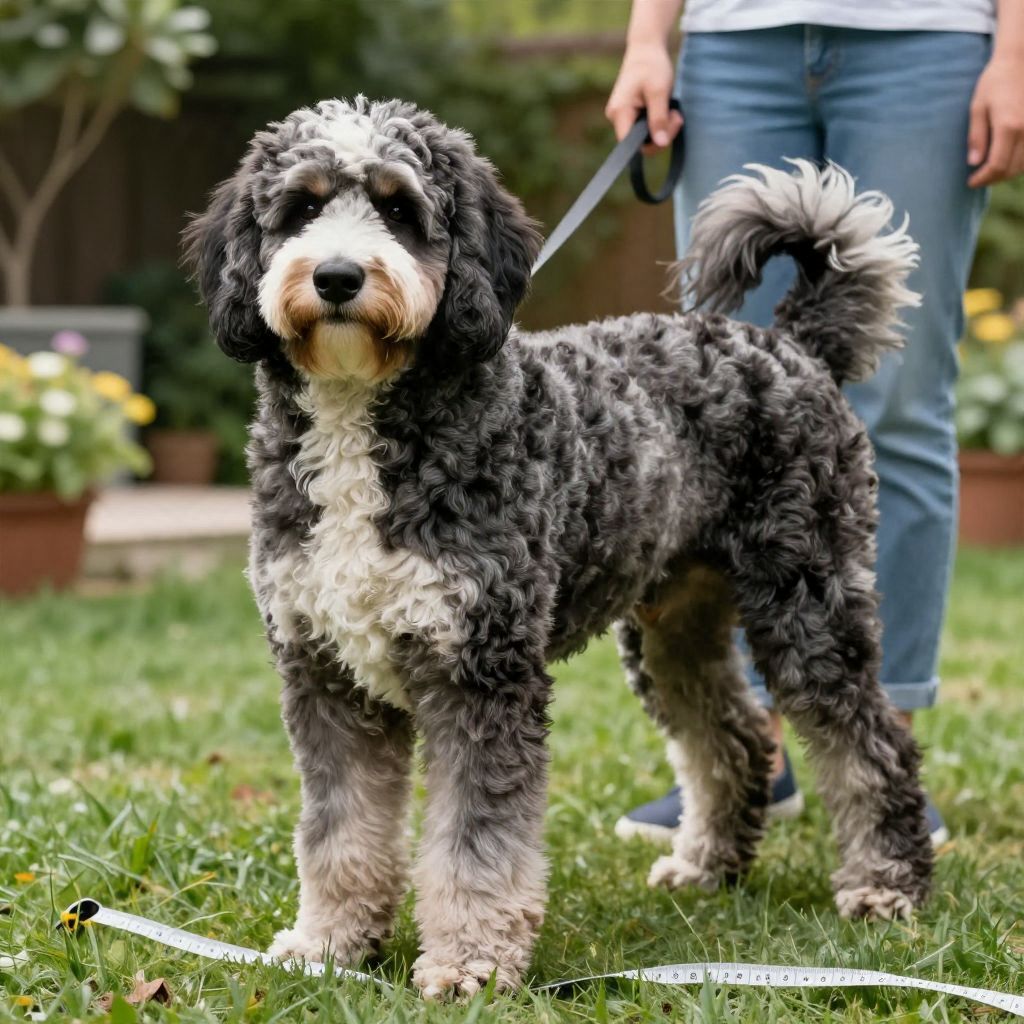
If you’re asking how big mini Bernedoodles get, the short answer is that most mature into a medium-small dog, but exact size can vary a lot. Their adult height and weight depend on the size of the parent dogs, especially the Poodle parent, plus genetics and sex.
Because “mini” is a size label rather than a guarantee, it helps to know the usual range, how growth works, and what to expect as your puppy matures. That way, you can plan for feeding, exercise, grooming, travel, and living space with fewer surprises.
How big do mini Bernedoodles get?
Most mini Bernedoodles grow to about 18 to 22 inches tall at the shoulder and roughly 25 to 49 pounds as adults, though some end up a bit smaller or larger. Their final size depends on breeding lines, parent size, sex, nutrition, and individual genetics, so no breeder can promise an exact adult weight.
What affects a mini Bernedoodle’s adult size?
Mini Bernedoodles are typically bred from a Bernese Mountain Dog and a Miniature Poodle, but the exact pairing can vary. That means two puppies from similar parents may still grow differently.
Common factors that influence size
- Parent size: The Poodle parent has a big influence on whether the puppy stays truly mini or trends larger.
- Generation: F1, F1b, and multigenerational dogs can vary in size because breeders use different combinations of parent sizes.
- Sex: Males are often somewhat larger than females, though not always.
- Genetics: Littermates can still mature differently.
- Health and nutrition: Proper feeding supports healthy growth, but overfeeding does not create a healthier or better-sized dog.
If you want a more predictable estimate, ask the breeder for the parents’ adult weights and heights, not just the puppy’s current size. Even then, the estimate is only a range.
How fast do mini Bernedoodles grow?
Mini Bernedoodles usually grow quickly during puppyhood and then slow down as they approach adolescence. Many reach most of their height by around 8 to 12 months, but they may continue filling out in muscle and body condition until 12 to 18 months or a little longer.
Growth rates vary, so it’s normal for a puppy to look leggy one month and more filled out the next. Focus on steady, healthy development rather than trying to force a certain size.
Signs your puppy is growing normally
- Steady weight gain without sudden spikes or drops
- Good energy and appetite
- Clear eyes, healthy coat, and normal stools
- Body shape that stays lean but not bony
If your puppy seems to be losing weight, is not eating well, or looks excessively thin or potbellied, check with your veterinarian.
Mini Bernedoodle size compared with other Bernedoodles
Mini Bernedoodles are smaller than standard Bernedoodles and usually larger than toy-sized doodle mixes. If you are trying to choose the right size for your home, think about more than just weight. Energy level, grooming needs, and training time matter too.
- Mini Bernedoodle: Often around 25 to 49 pounds
- Standard Bernedoodle: Usually much larger and better suited to homes that can comfortably manage a bigger dog
- Toy or petite doodle mixes: Smaller, but not the same as a mini Bernedoodle
If you are comparing doodle sizes, it can also help to look at similar breeds and mixes. For more size context, you may find how big Bernedoodles get useful.
How to estimate your puppy’s adult size
No method is perfect, but a few clues can help you make a reasonable estimate. Use them as a guide, not a promise.
- Ask for the adult size of both parents.
- Check the breeder’s expected adult weight range for the litter.
- Track your puppy’s weight over time rather than reacting to one week’s change.
- Ask your veterinarian whether growth is on track for your puppy’s age and body condition.
Some owners try to predict adult size from paw size or leg length alone, but those clues are unreliable. Puppies often look awkward before they settle into their adult proportions.
What size means for daily care
Knowing how big mini Bernedoodles get helps you prepare for practical care needs. A dog in the 30- to 45-pound range is still manageable for many families, but it is not a tiny lap dog and usually needs regular exercise, training, and grooming.
Feeding and body condition
Mini Bernedoodles should stay lean and well-muscled. Overfeeding during growth can stress joints and encourage unhealthy weight gain, especially in a dog that may already be prone to orthopedic concerns from larger-breed ancestry.
- Feed a complete, age-appropriate diet.
- Use measured portions instead of free-feeding unless your veterinarian advises otherwise.
- Adjust food as your puppy grows and activity changes.
- Ask your vet if you are unsure whether your dog’s body condition is ideal.
Do not use treats as a major part of the diet. Treats are fine for training, but they should stay within a small portion of daily calories.
Exercise needs
Mini Bernedoodles often do well with daily walks, play sessions, and mental enrichment. Their exact exercise needs vary by age and temperament, but they usually benefit from consistent activity rather than long bursts only on weekends.
- Puppies need short, age-appropriate sessions and plenty of rest.
- Adults often enjoy moderate daily exercise and training games.
- Older dogs may need gentler activity with more recovery time.
Because they are mixed-breed dogs, energy level can vary. Some are lively and athletic, while others are calmer and more laid-back.
Grooming and coat care
Mini Bernedoodles can have wavy, curly, or straighter coats, and coat type affects grooming more than size does. Regular brushing helps prevent tangles, and many dogs need professional grooming on a routine schedule.
- Brush several times a week, or more often if the coat mats easily.
- Check ears, paws, and the area behind the legs for tangles.
- Keep nails trimmed so growth and posture stay comfortable.
- Ask a groomer how often your dog should be clipped based on coat type.
Matting can become painful and can hide skin irritation, so don’t wait until the coat is tightly tangled.
Size-related health and safety considerations
Mini Bernedoodles are not giant dogs, but they are large enough to need safe handling and thoughtful management, especially as puppies. Their size can affect joint health, house training, and how you set up your home.
Protect growing joints
Avoid excessive jumping, repeated stair running, and long forced exercise in a young puppy. Controlled play is better than high-impact activity.
- Use ramps or steps when helpful.
- Keep play sessions short and supervised.
- Choose age-appropriate toys that are not too hard or too small.
Watch for signs of overexertion
Stop activity and contact your veterinarian if your dog shows limping, stiffness, reluctance to move, coughing during exercise, or persistent fatigue. These signs do not always mean something serious, but they should not be ignored.
Know the emergency red flags
Get urgent veterinary help if your dog has trouble breathing, collapses, has a swollen or painful abdomen, cannot stand, has repeated vomiting, or seems suddenly weak or disoriented. Those signs can be emergencies regardless of your dog’s size.
Training and socialization for a well-mannered mini Bernedoodle
Size affects handling, but training shapes day-to-day life even more. A mini Bernedoodle that weighs 35 pounds can still be difficult to manage if it pulls, jumps, or becomes anxious around new situations.
Reward-based training works well for most dogs and helps build trust. Start early with simple skills like name response, recall, leash walking, settle, and polite greetings.
- Reward calm behavior with treats, praise, or play.
- Practice handling for grooming and vet visits.
- Expose your puppy to friendly people, dogs, sounds, and surfaces in a safe way.
- Keep sessions short and positive.
If your dog shows fear, reactivity, or persistent anxiety, a certified trainer or veterinary behaviorist can help you build a plan without intimidation or punishment.
When to ask your veterinarian about size or growth
It is wise to check in with your veterinarian if your mini Bernedoodle seems much smaller or larger than expected, especially if growth is uneven. A veterinarian can assess body condition, diet, parasite control, and overall health.
Call your vet soon if you notice
- Poor appetite or sudden weight change
- Loose stools, vomiting, or frequent stomach upset
- Limping, stiffness, or reluctance to exercise
- Delayed growth compared with littermates or family history
- Excessive scratching, ear problems, or coat changes
These signs do not automatically mean a serious problem, but they do deserve professional attention.
Common mistakes owners make about mini Bernedoodle size
One of the biggest mistakes is assuming “mini” means very small. Mini Bernedoodles are often medium-small dogs, not toy dogs, and they need room to move, train, and mature.
- Choosing a dog based only on expected adult weight
- Overfeeding a puppy to “help” it grow
- Expecting all littermates to be the same size
- Ignoring grooming needs because the dog is smaller than a standard Bernedoodle
- Using size alone to judge exercise or training needs
Planning for the dog you are likely to get, rather than the smallest possible version, usually leads to better long-term care.
Bottom line
So, how big do mini Bernedoodles get? Most end up around 18 to 22 inches tall and 25 to 49 pounds, but individual dogs can fall outside that range. The best way to prepare is to expect a medium-small companion with ongoing grooming, training, and exercise needs, then adjust care as your dog grows.
If you’re still comparing doodle sizes, you may also want to read how big mini Goldendoodles get for another helpful size comparison.